
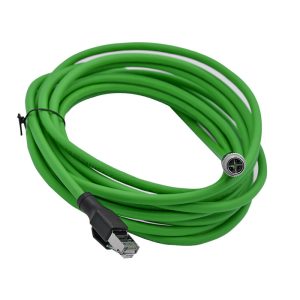
 “Please use a PUR cable” is a common request for industrial connector assemblies. Polyurethane jackets can offer useful resistance to abrasion and certain oils, making them attractive for demanding factory environments. But the word PUR describes the jacket material—not a universal rating for repeated motion.
A PUR-jacketed cable intended for fixed installation may perform poorly in a drag chain. Conversely, a cable with a different jacket material may be engineered for continuous flexing. Selecting the right assembly means separating environmental resistance from motion capability.
Start with the three types of cable movement
Fixed installation: The cable is routed once and remains substantially stationary. Flexibility matters for installation, but repeated-bend life may not.
Occasional movement: The cable bends during maintenance, repositioning or door opening. A flexible design and suitable strain relief may be enough if the movement is limited.
Continuous motion: The cable moves repeatedly in an energy chain, robot axis or other mechanism. Here, conductor construction, internal cable geometry, minimum dynamic bend radius and qualification for the specific movement become critical.
What PUR can—and cannot—tell you
A PUR outer jacket may be chosen for abrasion resistance, mechanical durability and compatibility with some industrial oils. The actual resistance depends on the formulation and operating conditions; review the manufacturer’s cable data rather than assuming that all PUR materials behave identically.
The jacket does not tell you the number of flex cycles a cable can withstand, its torsion capability or the minimum permitted bend radius. Those ratings belong to the complete cable design.
Why conductor and core construction matter
Frequent bending places stress on copper strands and on the way insulated cores are arranged within the cable. Fine-stranded conductors, optimized core lay and appropriate filling or support elements can contribute to dynamic performance.
A cable intended for occasional bending may have a different lay structure from a cable developed for millions of repetitive cycles. When evaluating a candidate, ask for the manufacturer’s intended application and test conditions—not a broad claim that the cable is “flexible.”
Minimum bend radius is an engineering limit
Bend radius is usually expressed in millimeters or as a multiple of cable outside diameter. A figure for fixed installation must not be substituted for a dynamic bend-radius value.
Compare the cable specification with the smallest actual bend in the machine, including the path near an overmold or cable gland. Tight routing at the connector exit can create a local stress concentration even when the drag chain itself has an acceptable radius.
Drag-chain and torsion ratings are different
A drag chain primarily exposes the cable to repeated guided bending; a rotating robot joint can expose it to twisting. Some assemblies experience both. A cable designed for one movement profile should not be assumed suitable for the other.
For robot applications, specify torsion angle, moving length, frequency, acceleration and any combined bending. If a supplier gives a flex-cycle claim, check the test radius, speed, stroke length and temperature before comparing it with another product.
Shielding needs its own motion assessment
Shielded signal or Ethernet cables may use braids, foils or combinations of shielding materials. In dynamic service, the shield construction has to tolerate the intended movement while maintaining the electrical performance the system requires.
For data cables, preserving pair geometry is also important. A good jacket and strong strain relief cannot rescue an assembly that has inadequate signal performance after repeated flexing.
Build strain relief into the connector assembly
The transition from flexible cable to rigid connector is a predictable stress point. Consider overmold shape, cable clamp design, exit direction, slack and movement at the attachment point.
Do not use the connector termination as the moving hinge. Where the machine layout permits, guide the cable so bending occurs along the cable body at a controlled radius instead of directly behind the connector.
Questions to send before asking for a quotation
Share the cable application (fixed, occasional flex, drag chain or torsion), movement stroke, minimum bend radius, estimated cycles, temperature, oil or chemical exposure, core count, conductor sizes, shielding needs and connector types.
If the design combines power and communication conductors, specify operating current and data requirements for each group. The final cable structure may need more attention than a standard off-the-shelf cordset.
The right selection starts with the duty cycle
The simplest way to avoid a cable failure is to describe how it actually moves. “PUR” is useful material information, but “PUR + drag-chain rated + dynamic radius + test conditions” is a much more actionable specification.
Fremi supports customized industrial connector and cable assembly discussions. Providing motion and environmental details early helps identify whether a standard cordset, a high-flex cable or a purpose-built harness is the appropriate starting point.
Frequently Asked Questions
Are all PUR cables suitable for drag chains?
No. PUR refers to a jacket material. Continuous-flex suitability must be supported by the design and applicable movement ratings or tests for the complete cable.
Can I use a drag-chain cable on a rotating robot?
Only if the cable is also suitable for the specified torsional movement. Repeated guided bending and twisting are different mechanical demands.
Why does the cable often fail near the connector?
The transition between a rigid connector and a moving cable can concentrate bending stress. Routing and strain-relief design are important alongside the cable choice.
Discuss Your Project with Fremi
Designing a moving cable harness? Share the connector type, bending or torsion conditions, cable length and electrical requirements with Fremi to discuss the right cable assembly approach.
Post time: October 22nd 2026
 Emily2014515